About | Project Members | Research Assistants | Contact | Posting FAQ | Credits

New Reading Interfaces Working Group » Research Reports

The New Reading Interfaces Working Group focuses on reading in the context of networked and multimedia communication environments. Some of our topics include text visualizations, alternative interfaces, immersive or VR environments for text. The following reports and papers reflect these research interests.

World Without Oil (ARG)

SummaryWorld Without Oil was an alternate reality game developed by Ken Eklund and Jane McGonigal, ITVS (Independent Television Service) Interactive and funded by the Corporation for Public Broadcasting.  Originally played between April 30 and June 1, 2007, World Without Oil was conceived as both an ARG and a “serious game,” in the sense of  the Woodrow Wilson International Center for Scholars 2002 Serious Games Initiative.  The game’s tag line—“Play it before you live it”—emphasized the what-if nature of the game: players were encouraged to explore what would change in their own realities in the event of a massive oil shortage.  Game makers provided rough parameters for the in-game reality (the price of oil, fuel availability) as well as character content (blogs, videos), but the game was aggressively user-driven.  The gamers’ task was to imagine the consequences of a massive oil crisis, communicate about their experience and explore creative strategies for dealing with the attendant difficulties.

Description:  After game designer Jane McGonigal dropped hints about her next project far in advance of its start date, ARG players at Unfiction.com discovered the site www.worldwithoutoil.com.  The website showed the text of a chat between eight “team members,” as well as descriptions of each of them.  Players learned the eight characters’ (known as “Eight To Save Our Country,” or 8TSOC) backstory:  they had met while stranded in a Denver airport during a blizzard, and struck up a friendship.  While at the airport they also encountered a character named Nico, who gave them reason to believe a serious oil shortage would strike the U.S. on April 30th (the game’s start date).

Given access to the characters’ screen names, players soon found their livejournals, blogs, and AIM handles, and began to make contact.  Players who communicated with the characters often found themselves pointed toward real-world, out-of-game articles and websites about energy shortages, survivalism, and oil dependence.  When the game officially started, on April 30th, the worldwithoutoil.com site went live in earnest, with links to character and player blogs, fictional in-game news stories, player-submitted videos and images, and an oil price counter.  It became apparent that the game world would run on an accelerated timeline:  one real-world day would equal a week of in-game time.

Much of the game’s content was player-produced; the website featured links to videos, stories, diary entries and images submitted by players who were countenancing, however virtually, the disruption of an energy crisis.  Players were also encouraged to come up with their own game missions, and the best ideas were awarded points in the form of carbon offsets. Adopted player missions included activities like “ped parties” (social events planned to occur within walkable/bikeable distances from homes), guerilla gardening, local food meals and finding commuting solutions for friends.

According to its own published FAQ, by the game’s end it had more than 1900 players.

Research Context:  Like most ARGs, World Without Oil forges a somewhat de-centralized network of participation, leveraging social networking sites, blogs, chat applications and image and video sharing services in order to connect its geographically diverse players.  Perhaps unlike classic ARGs, however, World Without Oil began with a conspicuously open-ended objective.  Its goal was playful; rather than the solution to a mystery or the accomplishment of a defined task, the object of WWO was to exercise imaginative power.  In contrast to some ARGs’ harnessing of collective intelligence in order to solve puzzles with pre-defined answers, players of WWO generated what the game makers called (in the game’s own FAQ) “the wisdom of crowds”:  a large collection of musings and ideas from which effective solutions could rise.  In WWO, the game was not to find what was hidden, but to imagine the virtual.

Without a concrete goal, and presented with an issue that had no absolute solution, players were free to imagine the proportions of an unmanageable crisis—and free to offer and practice micro-solutions.  The game was undertaken in a spirit of optimism, and while players were encouraged not to discount the sobering enormity of the problem it supposed, attention was focused (via character rhetoric and mission content, for example) on the creation of small strategies.  Game designer Jane McGonigal has written and spoken repeatedly in support of the idea that games and the power of play can be harnessed to address serious problems, and that perspective was clearly in evidence in WWO.  While many games that take on serious subject matter do so in order to heighten awareness of a threat or an injustice, WWO asked its players to investigate practical changes that might be effective during a debilitating oil crisis.  It is perhaps for this intersection—of serious game subject matter and ARG-like strategy—that the game is most notable.

Technical Analysis:  The technologies used by World Without Oil were largely the same as those leveraged by more traditional ARGs—blogging services, Twitter, photosharing services, etc.  Players communicated with each other and with game characters through multiple channels.  The game’s homepage—www.worldwithoutoil.com—served a more central hub than is available in many ARGs; that is, a single site that linked to almost all game content.

Evaluation of Opportunities/Limitations for the Transliteracies Topic:  World Without Oil  is notable for its divergence from traditional ARG structure and style.  Though ARG-like in its convergence of real-world and game-world realities, the game’s “serious game” credentials and lack of conventional puzzle-solving activity mark it as distinct from other ARGs. ARGs in general are player-directed to the extent that, though the general structure of the game is outlined by gamemasters, play itself is performed and made actual by the gamers themselves, and is subject to their own logic or desires; in WWO, there was perhaps even less guidance or expectation on the part of gamemasters, and more latitude given to gamers to construct their own experience(s).  Designer Ken Eklund described it this way:  “In World Without Oil, the players pretty much wrote the story collaboratively. As a result, in WWO there is no abstraction, no external reward, no comfort zone of  ‘Oh good, I found what the gamemasters wanted me to find.’ There is only the person directly inside the ‘what if?’ reality, and the journey is inward.”(1)   Put another way, ARG experience often centers on finding or uncovering points in an already-sketched (though mutable) plot, though the path through the plot-points are undecided.  WWO more closely resembled an improvisation:  players were asked to invest in a set of hypothetical circumstances and act accordingly, urged to create their own plots rather than asked to uncover those intended by the gamemasters.

ARGs conventionally ask for this sort of investiture in the game world, one that recalls Coleridge’s  willing suspension of disbelief (TINAG, an acronym for “this is not a game,” is a common watchword within the genre).  However, in WWO this engagement with the game’s premise required and empowered players to direct the game itself, rather than to do the more traditional work of uncovering a mysterious narrative. While ARG players are always both producers and consumers of game content and game experience, WWO displayed an innovative emphasis on players as cooperative producers and co-designers.  Most ARGs can be said to offer authorship to players primarily in terms of execution and performance, and only secondarily in terms of design.  In WWO, however, gamers were the ones doing the informing, reporting to gamemasters from a fictional present they themselves devised, inventing and giving account of the particulars of life inside an oil crisis.

Finally, in WWO, player action was part of a consideration of a pressing environmental, political and social issue.  “Acting accordingly,” then, provided an opportunity for changes to everyday practice more pointed than those prompted by conventional ARGs.  Part of ARGs’ appeal is their use of objects and practices that exist both in-game and out-of-game—for example, an actual poster for an upcoming movie contains a secret message or a puzzle clue for game players even as it fulfills its function as a piece of “real world” advertising.  In World Without Oil, the practices and objects splitting the in-game/out-of-game boundary were not only related to an issue of tremendous import, but involved the minutiae of everyday lives—highlighting, certainly, the problematics of oil dependence, but also allowing the game access to the intimate area of quotidian praxis.

(1) “The Future of Alternate Reality Games.” WWO Lives.  July 19, 2007.  August 28, 2008

Resources for Further Study:

World Without Oil

WWO lives:  Ken Eklund’s ongoing WWO blog

Jane McGonigal at GDC:  “Reality is Broken” (and how games can fix it)

Find The Lost Ring (ARG)

Summary: The Lost Ring is an alternate reality game developed by Jane McGonigal and San Francisco-based advertising agency AKQA in partnership with the International Olympics Coalition and the McDonald’s Corporation.   Developed both to celebrate and to advertise the 2008 Olympics in Beijing, the game is a massively multi-player, multi-national, intensely collaborative adventure in which players engage with a fictional game mythology through puzzle-solving and “real world” experiences. (more…)

The Lost Experience

Research Report by Renee Hudson
(created 06/03/08; version 1.0)
[Status: Draft]

Related Categories: Alternative Interfaces | Collective Reading

Original Object for Study description

Summary:
Between seasons two and three of the television show Lost, ABC launched “The Lost Experience,” an Alternate Reality Game (ARG) designed to maintain viewer interest in the show. “The Lost Experience,” like many ARGs, incorporated a variety of media into its implementation. Players were encouraged to watch commercials that aired during the last episodes of season two in order to be notified of relevant websites that would provide clues to the game. In addition to websites, users watched mini-movies, read advertisements, and a tie-in novel. They were also directed towards recordings and podcasts over the course of “The Lost Experience.” While the game itself is a multi-media experience, this report will focus on the textual elements that played a crucial role in the game. (more…)

Amazon Kindle

Research Report by Renee Hudson
(created 6/03/08; version 1.0)
[Status: Draft]

Related Categories: Hardware Innovations | Codex Book / Digital Text Hybrids | New Approaches to Reading Print Texts |

Original Object for Study description

Summary:
On November 19, 2007, Amazon released their electronic reading device, the Amazon Kindle. Within five and a half hours of its release, the Kindle sold out. In the following months, customers frequently had to wait 5+ weeks before a Kindle was ready for shipment, though at the time of this writing, the Kindle is in stock and ready to go. The Kindle store boasts over 115,000 titles for download, from blogs to books to online newspapers, all of which are ready for download in less than a minute. The Kindle differentiates itself from other electronic readers by offering Internet access free of charge and not requiring additional software in order to use.

Description:
Launched November of 2007, the much anticipated Kindle features E Ink technology and easy online access to the Kindle Store where users can purchase books and subscribe to magazines, newspapers, and blogs for a fee. Because these texts are downloaded to the Kindle, they can easily be accessed offline. Moreover, Amazon keeps a copy of all purchases on each user’s Amazon account in addition to the copy on the Kindle. The Kindle is equipped with a headphone jack and allows users to download both audiobooks (though this must be done as a download to a computer then to the Kindle via USB cable) and MP3s. For another small fee, users can wirelessly send documents to their Kindle email address. The Kindle currently supports unprotected Microsoft Word, HTML, TXT, JPEG, GIF, PNG, BMP, PRC and MOBI files. Though the PDF format is not fully supported at the time of this writing, the Kindle team is working on it. Alternatively, documents can be downloaded from a computer onto the Kindle using a USB connection.
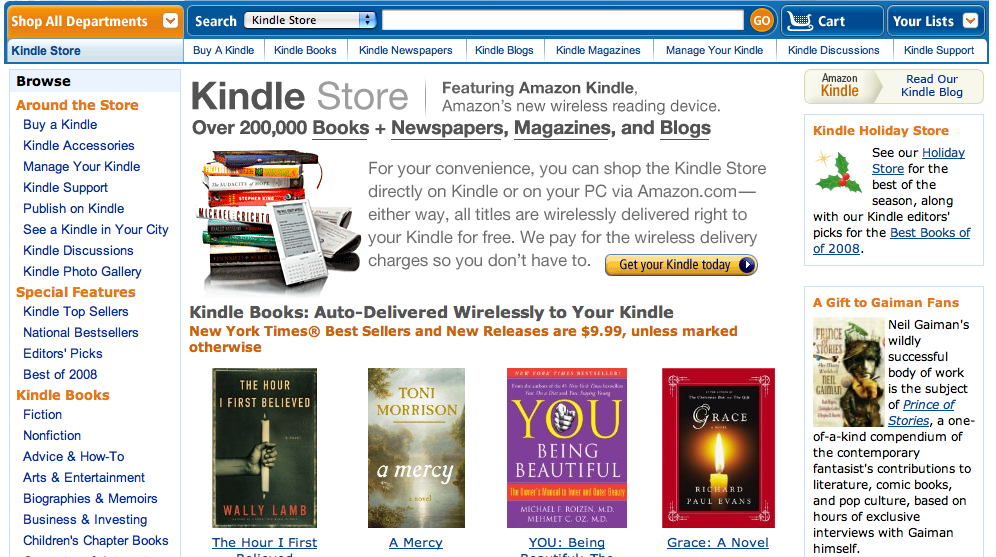
Users navigate books using buttons on either side of the Kindle to move to the next page or back to the previous page. The select wheel on the right hand side allows users to scroll up or down the cursor bar. For instance, should a user wish to highlight a selection of text s/he would use the select wheel to move to the line of text to be highlighted, then click the select wheel to mark that line. A box will open from which the user can either close, lookup a word using the dictionary that comes with the Kindle, add a highlight, or add a note. Selecting “add highlight” will mark the beginning line of the section to be highlighted. Another click to the appropriate line will complete the highlighted section. A qwerty keypad enables users to type in searches for texts in the Kindle store as well as specific phrases within texts already downloaded. For a given text, a user can easily look up all highlights and notes s/he has made to the text by choosing “my notes and marks” from the menu.

Pages within the Kindle are not numbered probably due to the fact that text size can be adjusted along a range of six different sizes. Because the screen is smaller than most book pages and text size varies according to one’s personal settings, users will often turn pages more quickly than in a typical book. However, after prolonged use with the Kindle, this aspect becomes rapidly unnoticeable. Additionally, the small size of the Kindle makes it less cumbersome to read over a long period of time than a typical book.

Navigating to a particular page (say in class or in a book club) can be challenging because of the lack of pagination. However, the Kindle makes navigation easier by allowing multiple bookmarks. A user can go to the menu and select “go to bookmark” to select from all their bookmarks. A handy trick for anyone using this in a classroom or professional setting would be to bookmark each chapter to allow for quicker navigation. Alternatively, a user can simply search for the phrase that begins the selection they are looking for. However, it should be noted that the delay between typing a letter on the keypad and it appearing on screen is longer than what one usually encounters with a keyboard.

Users can access the Internet to check email and search websites from their Kindle. Using the Kindle for such usage can be difficult because the interface does not appear to fully support web pages; consequently, pages are cluttered and difficult to navigate.

Research Context:
Because the Kindle is the latest manifestation of electronic readers, it is an object of interest for anyone interested in the development of reading interfaces, particularly as they stem from the printed page. With the goal of improving on printed books, the Kindle team at Amazon have created a number of features that reflect functionalities important to users / readers. Readers can highlight, search, add comments, and store documents on the device; all of these actions illustrate the way readers interface with texts while also demonstrating how this device streamlines the process.

Technical Analysis:
Like the Sony Reader, the Kindle uses E Ink technology in order to replicate the appearance of paper while eliminating the eye strain that other electronic displays cause. Electronic paper can be read from a variety of angles and in different lighting without the user suffering from glare or backlighting. Additionally, the technology allows for a display that minimizes power usage as power is only used to change pages, not maintain them.

The Kindle also utilizes Amazon Whispernet, which employs Sprint’s EVDO data network (the same technology used in cellular phones), to allow for wireless access to the Kindle Store. Unlike WiFi, users do not have to rely on hotspots in order to connect to the Internet. Moreover, the wireless service is free. Within seconds, they are online and able to download content from the Kindle Store.

The Kindle weighs in at a mere 10.3 ounces, features a six inch electronic paper display, and is 7.5” x 5.3” x 0.7.” Its resolution is 600×800 pixels at 167 ppi, with a 4-level gray scale.

The battery life depends on usage. Amazon estimates that users can expect to recharge (which takes no more than two hours) every other day if the wireless is left on, and about once a week if the wireless is kept off. Strangely, if the Kindle has not been used in a while, it needs to be recharged again before it will turn on.

The Kindle can store over 200 books, newspapers, magazines, and blogs. It has an SD memory card slot, which would allow users to store even more material.

There are not any system requirements as the Kindle does not need to sync to a computer, though users can use the USB cable that comes with it to hook up to their computers, similar to a flash drive.

Evaluation of Opportunities/Limitations for the Transliteracies Topic:
As the latest manifestation of the attempt to create an electronic device for reading, the Amazon Kindle is part of a lineage of electronic readers that seek to improve upon the technology of a typical book. Like electronic readers before it, rather than re-imagining the book, it attempts to improve on the model of the book by building on electronic capabilities. In terms of the success of the Kindle (aside from Amazon’s sales figures), and other readers like it, it is interesting to note that they have yet to catch up to the ubiquity of the book.

Fundamentally, the Kindle seeks to replicate the experience of reading a book, which does little to change the actual interface of the device. Amazon sought to make the Kindle “as easy to read as your favorite book,” a statement that testifies to the relatively small differences between the screen of the Kindle and the page of the book. Despite this similarity, by virtue of its being an electronic device, the Kindle allows users capabilities and conveniences that books are not able to provide. One such convenience is the Kindle’s ability to hold several texts on one device, making it ideal for traveling or any situation that requires one to save space by taking a limited amount of reading material. The Kindle is an excellent research tool since it allows for functions that are absent from books. The main example of this is the search capability. A user seeking to compare the use of a particular word between two texts, for example, can do so much faster than if s/he were to do it by going through each book individually.

The Video Demonstration for the Kindle claims to change how one reads. While this is not evident from certain functionalities like highlighting and adding notes (all actions that readers often do), it is true in terms of other functionalities like clipping and searching the text. Moreover, the Kindle changes when and where one reads. For instance, for readers like college students who often read with a pen in hand, reading on the road is often difficult if one attempts to underline and make notes. The Kindle streamlines this process, allowing users to read and annotate in a variety of settings. The Kindle holds the user’s place in each reading item automatically, making finding one’s place a needless concern. This functionality, combined with the ability to dog-ear pages or even highlight where one left off makes it even easier to get “into” the book since users do not have to waste time searching for where they left off.

Simply because the Kindle team insists on having tools like highlighting, clipping, etc., they necessarily change the reader’s relationship to the text. While a person picking up a book may choose to read the book and leave it at that, the Kindle user, aware of the tools, knows that reading the book straight through is a possibility, but one among many other options. The Kindle user is encouraged to look up words, search for phrases; in other words s/he is expected to go beyond the basic practice of reading.

Resources for Further Study:
CommentPress

Research Report by Kim Knight
(created 5/07/08; version 1.0)
[Status: Draft]

Related Categories: Blogging and Content Management Systems | Social Networking Systems | Tools for Online Reading

Original Object for Study description

Summary:

CommentPress was developed by the Institute for the Future of the Book as part of their ongoing experiments with “networked books”. First instituted in 2006 as part of McKenzie Wark’s GAM3R 7H3ORY 1.1 publication, the software was developed to work with WordPress and intended to reconfigure the nature of blog discussions. CommentPress allows respondents to post comments in the margin of the text, on a paragraph-by-paragraph or “whole page” basis. This breaks down the top-down hieararchy typical of blogs whereby a main post is positioned vertically above any commentary. Instead a reader may view the text and commentary at the same time.

Version 1.0 of CommentPress was released to the general public in July 2007 and the software has been used to generate discussion around Master’s Theses, scholarly articles, and books. (more…)

Interface Ecology

Summary:
Interface ecology is a theoretical framework for the study of relationships between interfaces; its objects range from social to computer interfaces. The practice of interface ecology is characterized by three intertwined objectives: the analysis of interfaces as cultural artifacts from an ecosystems approach, the production of systems and interfaces that elevate the role of human expression, and the translation between disparate cultures and disciplines. This approach was first theorized by Andruid Kerne through his own interdisciplinary work in performance art and computer science at New York University (1997-2001). He has published on interface ecology primarily within computer science and digital art forums from this period to the present. Five years ago, Kerne established the Interface Ecology Lab at Texas A&M University. (more…)

Remembrance of Media Past (Ayhan Aytes)

Summary:
Remembrance of Media Past engages with cultural archetypes as motivations for designing interfaces in contemporary media. I chose to take illuminated manuscripts as a central focus of my research because they were perhaps the most significant medium of complex information structures before the introduction of the mechanical reproduction beginning with the Gutenberg era. In its final articulation, the project components attempt to link these antecedent cultural interfaces to more current approaches to complex information structures. (more…)

Peter Cho, “Typotopo”

Research Report by Kate Marshall
(created 4/27/07; version 1.0)
[Status: Draft]

Related Categories: Text Visualization | Text and Multimedia

Original Object for Study description

Summary:
Peter Cho’s body of typographic experiments, collected on Typotopo, visually explore the constituent parts of language and narrative. Cho’s work presents a range of graphic design innovations that use digital technology to access forms of letters or forms of texts. The text visualizations showcased on Typotopo ask not only how technology influences typography, but also what happens to the act of reading when letters, words, and narratives are experienced in interactive, dynamic environments.

(more…)

WordsEye: An Automatic Text-to-Scene Conversion System

Research Report by Nicole Starosielski
(created 3/13/07; version 1.0)
[Status: Draft]

Related Categories: Text and Multimedia | Alternative Interfaces | Text visualization

Summary:

WordsEye is a text-to-scene conversion tool that allows users to construct a computer modeled scene through the use of simple text. Users describe an environment, objects, actions and images, and WordsEye parses and conducts a syntactic and semantic analysis of these written statements. The program assigns depictors for each semantic element and its characteristics and then assembles a three-dimensional scene that approximates the user’s written description. This scene can then be modified and rendered as a static two-dimensional image. (more…)

Noah Wardrip-Fruin’s News Reader (2003) (with David Durand, Brion Moss, and Elaine Froehlich)

Research Report by Brooke Belisle
(created 2/21/07; version 1.0)
[Status: Draft]

Related Categories: New Approaches to Reading Print Texts, New Reading Interfaces

Original Object for Study description

“It is difficult to get the news…”

Summary:
In 2003, New Radio and Performing Arts commissioned two artworks by Noah Wardrip-Fruin for their website, Turbulence.org. [1] Wardrip-Fruin produced Regime Change and News Reader, both of which he titled “Textual Instruments.” News Reader offers an interface for reading current news stories, and for what Wardrip-Fruin calls “playing” these stories or “playing” the online news environment. [2]As the user interacts with the news stories by clicking highlighted text, the stories multiply and warp in unpredictable ways. (more…)

LibraryThing

Research Report by Kimberly Knight
(created 2/19/07; version 1.0)

Related Categories: Text Visualization | Social Networking Systems | Online Knowledge Bases

Original Object for Study description

Summary:
LibraryThing is an online knowledge base and social networking tool for bibliophiles. The website allows users to catalog their personal libraries. By entering in their own books, users can locate others with similar libraries, find suggestions for books they might like, or even get “unsuggestions” for the books that are least like their own. Users can organize their collections according to self-defined tags and also view how others have tagged the same books. (more…)

Brian Kim Stefans, “The Dreamlife of Letters” (2000)

Research Report by Kim Knight
(created 2/18/07; version 1.0)

Related Categories: New Reading Interfaces | Text and Multimedia | Collective Reading

Original Object for Study description

Summary:
“The Dreamlife of Letters” is a flash poem by Brian Kim Stefans. Published in 2000, the piece is based upon an appropriated poem by Rachel Blau DuPlessis and takes the viewer through the mobile and unstable “dreamlife” of letters. The words of DuPlessis’ poem have been grouped together according to their first letter and animated in such a way that the passive viewer can only watch as the text moves around the screen. Influenced by the traditions of concrete poetry and ambient poetics, the piece foregrounds language not only as a medium of meaning, but also as a medium of design. (more…)

CaveWriting and the CAVE Simulator

Research Report by Nicole Starosielski
(created 2/6/07; version 1.0)
[Status: Draft]

Related Categories: Immersive Text Environments | Alternative Interfaces

Original Object for Study description

Summary:

Cave Writing is an interdisciplinary artistic practice developed at Brown University for the CAVE simulator, a virtual reality environment typically used for scientific visualization. Cave Writing began in 2002 when hypertext fiction writer Robert Coover initiated a series of workshops in Brown University’s CAVE that brought together faculty, students, artists and scientists in the development of creative projects integrating text, visual imagery, narrative and sound. Several notable projects from the workshop include Screen, developed by Noah Wardrip-Fruin, et al., John Cayley’s Torus and William Gillespie’s Word Museum. The release of CaveWriting 2006, a spatial hypertext authoring system designed by workshop developers, allows authors to directly manipulate text, imagery and 3D models in a graphical front-end environment. CaveWriting now expands beyond the physical limits of the CAVE simulator, making it relatively easy for anyone with a compatible personal computer to experiment and explore writing and reading in three dimensional environments. (more…)

Giselle Beiguelman, “esc for escape” (2004)

Research Report by Lisa Swanstrom
(created 12/15/06)
[Status: Draft]

Related Categories: Text Encoding | Text and Multimedia | Art Installations

Original Object for Study description

Summary:
“Tell us: What was the most scary, funniest, unforgettable error message of your life?” So asks Giselle Beiguelman’s “esc for escape,” (2004) a multifaceted art project that solicits and archives error messages from computer users around the globe and re-expresses them in a variety of contexts and media. The project includes a public exhibition of error messages on electronic billboards in São Paulo, Brazil; a repository of selected error messages published on the web, entitled “The Book of Errors”; “The Monastery,” an archive of all error messages related to the project; a dvd of the project; a project blog; as well as several “trailers,” which offer ironic visualizations of various error messages by the artist. (Can this sentence be broken up into 2?) In addition to providing a playful space for people to express their most “unforgettable” error messages, the project offers a subtle—yet sustained and sophisticated—commentary about the relationship between computer code and natural language in relation to the digital age. (more…)

Giselle Beiguelman, The Book after the Book (1999)

Research Report by Kimberly Knight
(created 11/04/06; version 1.2, updated 12/01/06)

Related Categories: New Reading Interfaces | Text and Multimedia | Literacy Studies

Original Object for Study description

Summary:
The Book after the Book by Giselle Beiguelman (1999) is an extended commentary upon online reading in the form of an online hypertext. Set against a flickering background of javascript, the prologue reads, “After more than 500 years, we are facing the development of a new form of written culture which is an hybrid of digital and printed substrata. The library idea does not organize knowledge anymore. It functions as node of a network, a set of revolving shelves, a new reading machine.” Modeled after Jorge Luis Borges’ “Book of Sand,” The Book after the Book seeks an understanding of the ways in which hypertext and online reading change the ways we think about the book as volume, the library as place, and the relationship between image and text. The work includes the artist’s commentary on online reading as well as a repository of links to various “ways of reading” online. (more…)

Collex

Summary:
Collex is a tool developed at the University of Virginia’s Applied Research in Patacriticism lab (ARP) and currently operated in conjunction with NINES (Networked Interface for Nineteenth-century Electronic Scholarship). Described as an “interpretive hub,” (Nowviskie) Collex acts as an interface for nine different peer-reviewed, scholarly databases. The interface allows users to access all nine databases in one search, while results retain the unique characteristics of each individual source. Additionally, users can create exhibits for their own personal use, or they may submit exhibits to be shared with all users. As such, Collex and its relationship to data evolves as users interact with it, relying on folksonomy and user-generated relationships to construct new ways of viewing the information it contains therein. (more…)